A fully automatic oil dielectric breakdown voltage tester is a key piece of equipment used to measure the dielectric strength of insulating oil, and is widely used in power equipment maintenance, transformer oil testing, and other fields. Below, we will analyze the advantages and disadvantages of this equipment in detail.
1. Advantages of the fully automatic oil dielectric breakdown voltage tester:
① High degree of automation, freeing up manpower:
a. Fully automated operation: From sample preparation and voltage boosting to data processing, the instrument can automatically complete a series of operations including oil cup cleaning, sample injection, voltage boosting, breakdown detection, data recording, statistical analysis, and report generation. For example, Wuhan Ultra-High Voltage's automatic insulating oil dielectric strength tester supports "one-button start of the entire process," eliminating the need for manual voltage boosting and recording of breakdown voltage, significantly reducing manual labor intensity.
b. Convenient operation: Operators only need to set the test parameters (such as voltage boosting rate and number of tests) and place the sample to start the test process, avoiding the influence of human operational errors on the test results. Some instruments are equipped with a large-screen color touch screen and a backlight system, making operation clear and convenient even at night. Test parameters can be saved for a long time once set, greatly improving work efficiency.
② High accuracy and reliable data:
a. High-precision measurement module: It uses a high-precision voltage sampling module and a fast-response breakdown detection circuit, which can accurately collect voltage signals during the voltage boosting process and promptly capture the voltage value at the moment of insulating oil breakdown. The voltage measurement error can be controlled within ±1%. For example, Wuhan Ultra-High Voltage's tester has a breakdown voltage measurement range of 0-80kV and an accuracy of ±1%, fully meeting the requirements of the GB/T 507 standard.
b. Strong anti-interference ability: Built-in anti-interference circuit effectively resists external electromagnetic interference, ensuring stable operation and reliable test data output even in complex laboratory or field environments. Some instruments adopt a "hardware shielding + software filtering" dual design; the all-metal shielded casing blocks radiation interference, and the voltage boosting module uses high-frequency switching power supply technology to avoid the influence of power grid harmonics. ③ Comprehensive Safety Protection:
a. Multiple Protection Mechanisms: Built-in multiple protection devices such as overvoltage, overcurrent, and limit switches. When the instrument detects abnormal conditions such as high-voltage leakage, circuit overcurrent, or overvoltage, it will immediately cut off the high-voltage output, stop the test process, and emit an audible and visual alarm signal, effectively preventing high-voltage electric shock accidents and ensuring the personal safety of operators. For example, the instrument is equipped with overvoltage protection, overcurrent protection, and breakdown protection. Once the oil sample breaks down, the instrument will cut off the high voltage within 0.01 seconds and also trigger an audible and visual alarm.
b. Safety Design Details: Adopts door interlock protection; the door of the high-voltage test area can only be opened when it is closed, and the high voltage is automatically cut off when the door is opened, preventing accidental entry and electric shock; upper and lower limit switches are set to ensure that the voltage is tested within the range of zero to full scale, and the high voltage is automatically cut off when the voltage reaches the limit during the voltage adjustment process, preventing over-range voltage.
④ Rich Functionality and Strong Adaptability:
a. Multiple Test Modes: Supports continuous multiple tests (e.g., 6 times), automatically calculates the average value, and after removing abnormal data, calculates statistical parameters such as the average value, maximum value, and minimum value, finally generating a complete test report. It also supports a single automatic test mode, automatically completing one test and printing the single test data.
b. Strong Standard Compatibility: Pre-set with various international and domestic standards (such as DL429.9 - 91, GB/T507 - 2002, IEC60156, etc.), and supports user-defined methods, adapting to various insulation oil testing scenarios such as transformer oil, circuit breaker oil, and capacitor oil.
c. Good Environmental Adaptability: The product is compact and lightweight, possessing both precise laboratory testing capabilities and outdoor field operation capabilities, adapting to complex working conditions with different ambient temperatures and relative humidity.
⑤ Convenient Data Management and Transmission:
a. Data Storage Function: Supports storage of a large amount of experimental data and power-off data retention, facilitating data traceability and analysis. For example, some instruments can store 100 sets of experimental data.
b. Data Transmission Interface: Some instruments support data transmission interfaces such as USB and Ethernet, allowing real-time uploading of test data to a computer for data storage, management, and traceability, facilitating quality analysis and report generation for users. 2. Disadvantages of the fully automatic oil dielectric breakdown voltage tester:
① Relatively high price: Due to the use of advanced automation technology, high-precision measurement modules, and comprehensive safety protection design, the manufacturing cost of the fully automatic oil dielectric breakdown voltage tester is higher. Therefore, its price is relatively higher than traditional manual testing instruments or some semi-automatic instruments, which may be a consideration for some users with limited budgets.
② Requires certain technical skills from operators: Although the instrument has a high degree of automation and is relatively easy to operate, operators still need to possess certain electrical knowledge and testing experience to correctly set test parameters, understand test results, and handle possible abnormal situations. If the operator lacks relevant knowledge and experience, it may lead to inaccurate test results or the inability to promptly handle instrument malfunctions.
③ Higher maintenance requirements: To ensure the normal operation of the instrument and the accuracy of test results, regular maintenance is required, such as cleaning the oil cup, checking the electrodes, and calibrating the instrument. If maintenance is not timely or not performed correctly, it may affect the instrument's performance and test results.
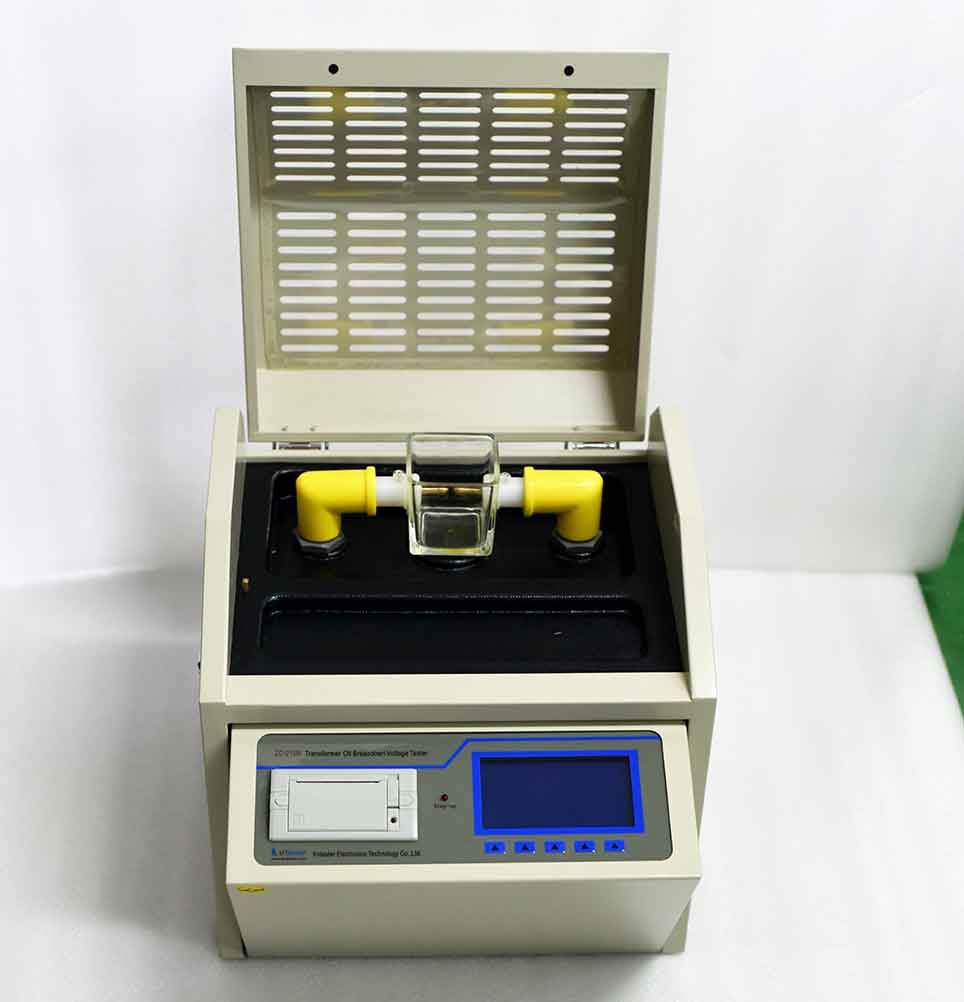
The ZC-210B fully automatic insulation oil dielectric strength tester is a high-precision, fully digital industrial instrument developed by all scientific and technical personnel of our company, in accordance with the relevant provisions of the national standard GB/T 507-1986 and industry standards DL/T 474.4-2006 and DL/T 596-1996, and leveraging its own advantages through multiple on-site tests and long-term unremitting efforts. To meet the needs of different users, this series of instruments can be divided into single cup three cup and multi cup models. The instrument is easy to operate and has a beautiful and elegant appearance. Due to the use of fully automatic digital microcomputer control, it has high measurement accuracy, strong anti-interference ability, and is safe and reliable.
Kvtester Electronics Technology Co.,Ltd. is a high-tech enterprise specializing in power testing, testing, research and development, production, and sales of testing equipment. It has been engaged in the electrical testing industry for many years, and its products are of high quality. We welcome customers to come and purchase. Service hotline: 0086-27-81778799, to learn more, visit the official website: www.kvtester.com