When using a three-phase relay protection tester for pre-fault state testing, it is necessary to set parameters, connect equipment, and simulate normal operating conditions according to standard procedures. Time control and triggering methods must be used to ensure the tester accurately enters the pre-fault state. The following are the specific operating steps and precautions:
1. Test Preparation
① Equipment Connection:
According to the test requirements, connect the voltage, current, and control circuit terminals of the three-phase relay protection tester to the corresponding terminals of the relay protection device under test.
Ensure that the wiring is secure to avoid poor contact or short circuits.
② Parameter Settings:
Turn on the three-phase relay protection tester, perform a system self-check, and confirm that the display screen, buttons, and output modules are working correctly.
Set the basic system parameters, such as rated voltage, rated current, and power frequency, ensuring they match the rated parameters of the protection device under test.
According to the type of protection being tested (e.g., overcurrent, zero-sequence, undervoltage, etc.), select the corresponding test mode, such as "single-phase test," "three-phase test," or "switching quantity test."
③ Test Parameter Settings:
In the test parameter settings interface, set the relevant parameters for the pre-fault state, such as pre-fault delay and test interval time.
Pre-fault delay: This time is commonly used to wait for the protection group to reset after each operation, or for the "TV disconnection" signal to disappear, or to wait for reclosing charging. If only protection setting testing is performed without reclosing, this time is generally set to 2-10s. If reclosing testing is also performed, it is generally set to 15-25s.
2. Pre-Fault State Testing
① Start the Tester:
After confirming that all parameter settings are correct, start the three-phase relay protection tester.
The tester will enter the ready state, waiting to start the test.
② Enter the Pre-Fault State:
According to the set pre-fault delay time, the tester will output a three-phase rated voltage (e.g., 57.7V) and a three-phase current of 0, simulating the normal operating conditions before a fault.
In this state, observe the reaction of the relay protection device under test and confirm that it is in a normal working state. ③ Triggering Fault State (Optional):
If fault state testing is required, after the pre-fault state ends, the test instrument can be switched to the fault state using a defined trigger method (such as time control, button trigger, input trigger, or GPS trigger).
In the fault state, the test instrument will output the set fault quantities (such as overcurrent, overvoltage, undervoltage, etc.) to simulate fault conditions in the power system.
3. Precautions
① Safe Operation:
Before conducting the test, ensure that the tested relay protection device is disconnected from the primary equipment and that the device's power supply is switched off and discharged.
Operators must take insulation precautions, wear insulating gloves and shoes, and set up safety warning signs at the site.
② Parameter Accuracy:
When setting test parameters, ensure the accuracy of the parameters to avoid inaccurate test results or equipment damage due to incorrect parameter settings.
③ Observation and Recording:
During the test, closely observe the response of the tested relay protection device and the output data of the test instrument.
Record the test data and analysis results promptly for subsequent processing and evaluation.
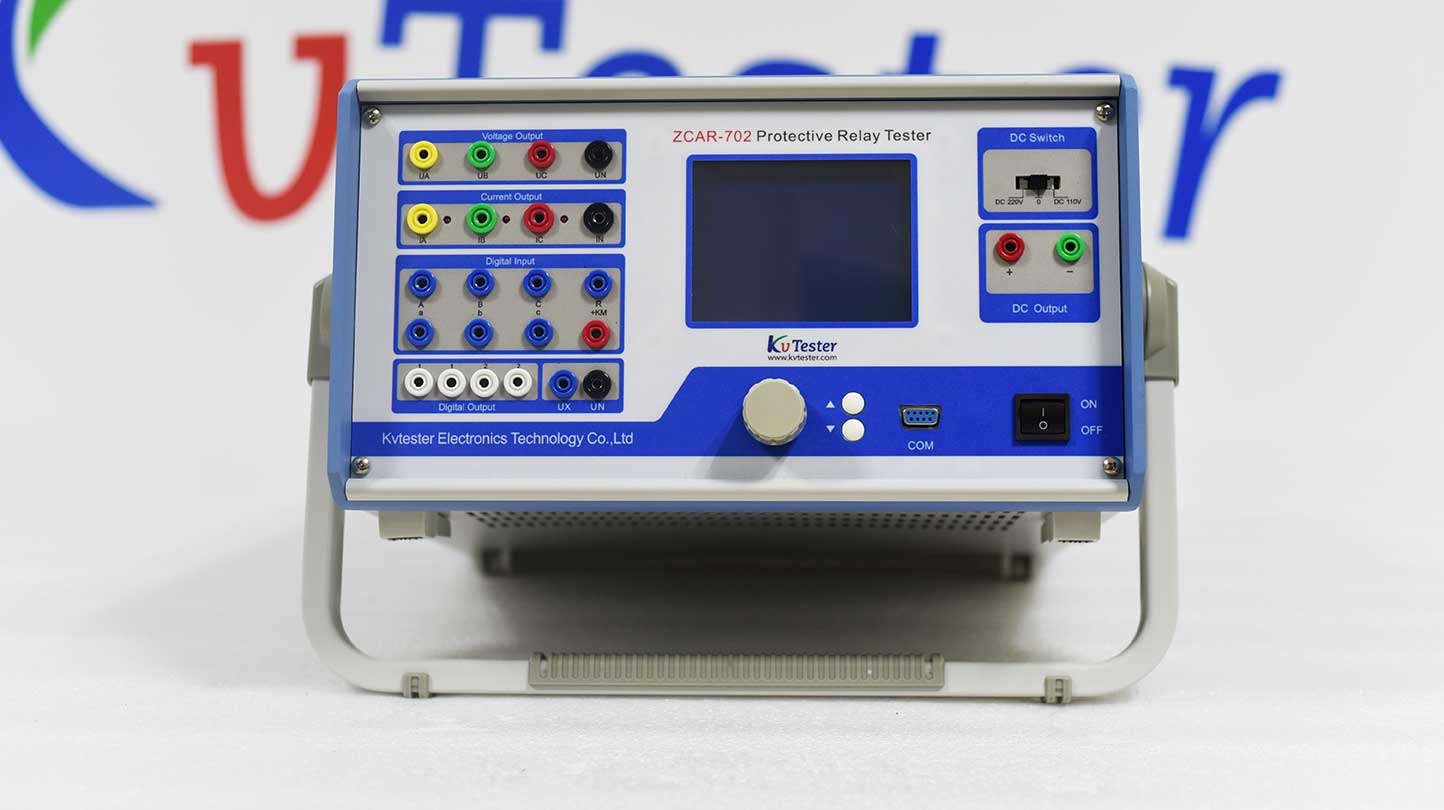
The ZCAR-702 three-phase relay protection tester comes with a large screen LCD display and a flexible and convenient rotating mouse controller. Single machine independent operation already has strong functionality and can perform most experiments, while connecting to a computer for operation has even more powerful operational capabilities. Small size and high precision. It not only has the superior performance and advanced functions of large testers, but also has the advantages of small and flexible testers, easy operation, and high reliability, with a high cost performance ratio. It is a handy tool for relay protection workers. In addition to being able to calibrate various relays (such as current, voltage, inverse time limit, power direction, impedance, differential, low cycle, synchronous, frequency, DC, intermediate, time, etc.) and microcomputer protection, it can also simulate transient, permanent, and conversion faults from single-phase to three-phase for whole group testing. It can also complete various highly automated large-scale complex verification tasks, automatically test and scan various protection settings, store test data in real time, display vector graphics, and print reports online.
Kvtester Electronics Technology Co.,Ltd. is a high-tech enterprise specializing in power testing, testing, research and development, production, and sales of testing equipment. It has been engaged in the electrical testing industry for many years, and its products are of high quality. We welcome customers to come and purchase. Service hotline: 0086-27-81778799, to learn more, visit the official website: www.kvtester.com