Digital partial discharge detector is a precision electronic instrument used to detect partial discharge phenomena inside high-voltage electrical equipment. Its core function is to capture and analyze the pulse signals generated by discharge, evaluate the insulation status of the equipment, and prevent safety accidents caused by insulation faults. The following will provide a detailed explanation of the advantages and disadvantages of digital partial discharge testers:
1. Advantages of digital partial discharge tester:
① High precision detection and quantification capability
a. The detection sensitivity is extremely high, for example, some instruments can reach 0.002pC, which can accurately capture weak discharge signals and meet the requirements of IEC 60270 standard for quantifying discharge capacity.
b. The sample capacitor has a wide coverage range (such as 6pF-250 μ F) and is suitable for type testing, factory inspection, and on-site fault diagnosis of high-voltage equipment such as transformers, cables, and lightning arresters.
c. Support high-frequency detection (such as 10kHz-300kHz multi adjustable), covering multiple frequency bands such as ultra-high frequency (UHF) and ultrasound, adapting to the discharge characteristics of different devices.
② Intelligent data analysis and diagnosis
a. Equipped with PRPD/PRPS spectrum analysis function, it automatically identifies discharge types (such as corona, suspension, and surface discharge) through parameters such as phase distribution and pulse sequence, with an accuracy rate of ≥ 80%.
b. Support two-dimensional and three-dimensional graph display (such as Q - φ, N - φ, Q - φ - T), providing richer information and facilitating the discharge and interference of pulses in the district.
c. Built in discharge type library and intelligent diagnostic algorithm, which can compare historical data and quickly generate fault prediction reports.
③ Strong anti-interference design
a. Adopting digital windowing technology, it supports any phase windowing (single/double window) and elliptical 360 ° rotation, effectively isolating interference such as power frequency and radio.
b. Equipped with a mixed analog and digital filter, the bandwidth can be freely combined to suppress background noise and improve signal-to-noise ratio.
c. Some instruments support pulse polarity discrimination or balanced measurement circuits to further eliminate interference pulse signals.
④ Convenient operation and humanized design
a. Portable design, weighing approximately 17kg, compact size (such as 502 × 502 × 210mm ³), suitable for on-site inspection needs.
b. Large touch screens (such as TFT screens) support gesture operations and can freely switch between oval, straight, and sine wave display modes.
c. Easy to operate and learn, suitable for use by power departments, manufacturers, and research institutes.
⑤ Scalability and compatibility
a. Support multi-channel synchronous acquisition (such as dual channel, four channel), and can be simultaneously connected to high-frequency current transformers (HFCT), ultrasonic sensors (AE), ultra-high frequency sensors (UHF), etc., to achieve electrical acoustic electromagnetic joint detection.
b. Provide open data interfaces (such as USB, Ethernet), support data export to PC or third-party software (such as MATLAB, Python) for deep analysis.
c. Compatible with power industry standard protocols such as IEC 61850 and DL/T 860, it can be integrated into substation automation systems (SAS).
⑥ Automation and intelligent functions
a. Support full process control, automatic calibration, automatic synchronization, automatic voltage recording, automatic measurement, saving and playback, reducing manual intervention.
b. It can store a large amount of experimental data and waveforms, support real-time retrieval and analysis, and automatically generate test reports with both graphics and text.
c. Some instruments are equipped with cameras and RFID functions for easy inspection recording and IoT expansion.
2. Disadvantages of digital partial discharge tester:
① The trade-off between high sampling rate and resolution
Some high-end desktop instruments may have limited vertical resolution (usually below 12 bits) under high sampling rates (such as GS/s level) and high bandwidth conditions, which increases the difficulty of resolving weak discharge signals.
② Limitations of triggering function
Mid to low end instruments may only support amplitude triggering and cannot achieve composite conditions such as phase correlation triggering, making it difficult to stably capture weak or complex signals.
③ Storage capacity and continuous acquisition requirements
The storage depth of ordinary instruments may be insufficient, and they rely on external devices (such as external hard drives) to achieve long-term continuous data acquisition, which poses a risk of data loss.
④ The contradiction between portability and performance
High end desktop instruments have a large volume, heavy weight, and usually do not have a portable power supply, making it difficult to meet on-site portability needs; Although handheld inspection devices are portable, their bandwidth, sampling rate, and vertical resolution may be insufficient, affecting high-performance detection.
⑤ High cost
Due to its high technical complexity and rich functionality, digital partial discharge testers are usually priced higher than traditional analog instruments, which may increase user procurement costs.
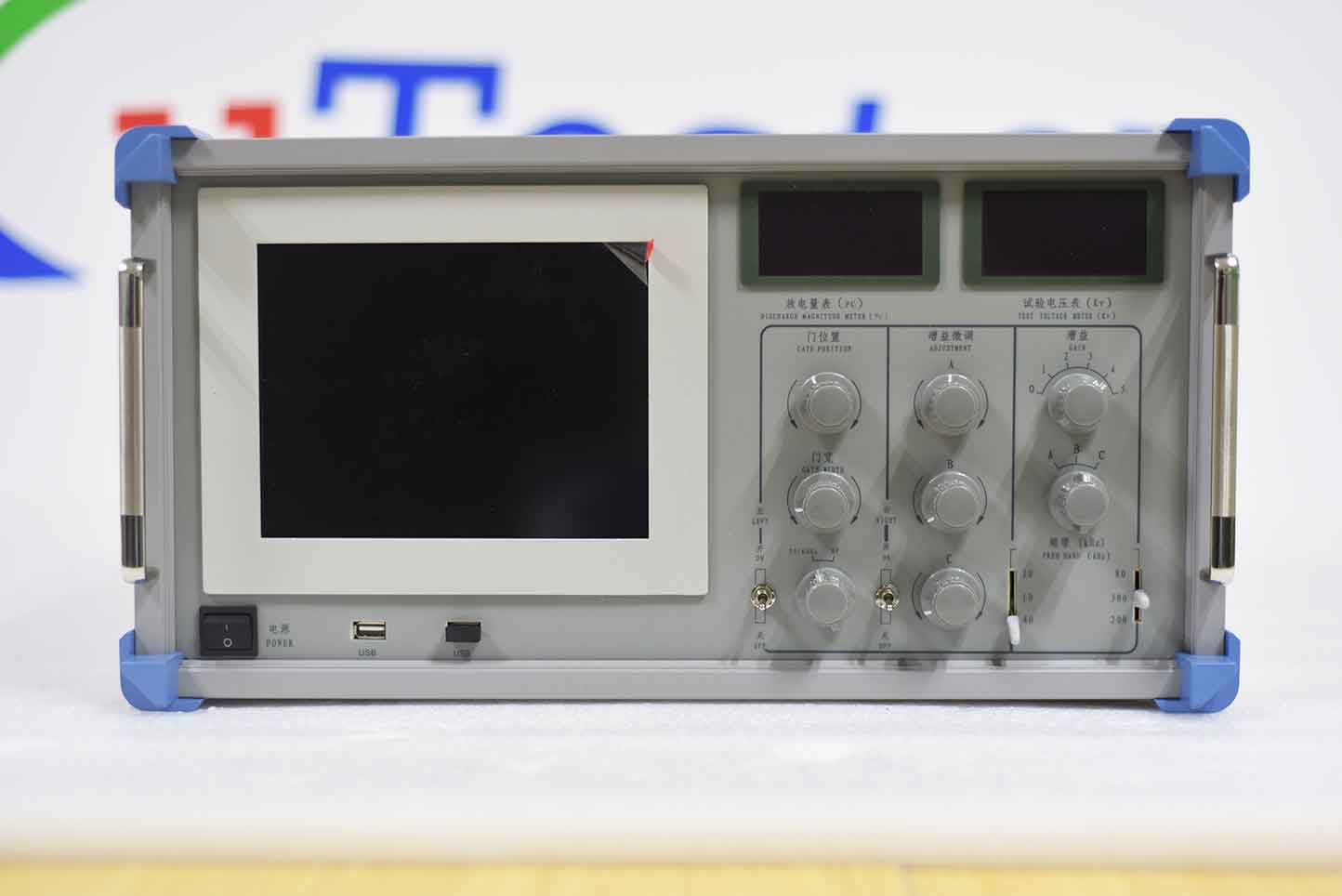
ZC-254B Three channel partial discharge detector is a new digital liquid crystal display partial discharge detector developed by our company to solve the problems of low brightness and short service life of the oscilloscope tube of the traditional partial discharge instrument.The instrument has the advantages of high detection sensitivity of mature products, large sample capacitance coverage, wide range of applicable samples, complete input units (detection impedance) and multiple frequency band combinations (nine kinds). The operation, structure and installation form are fully compatible with previous models, which is convenient for the upgrading of existing system equipment.
Kvtester Electronics Technology Co.,Ltd. is a high-tech enterprise specializing in power testing, testing, research and development, production, and sales of testing equipment. It has been engaged in the electrical testing industry for many years, and its products are of high quality. We welcome customers to come and purchase. Service hotline: 0086-27-81778799, to learn more, visit the official website: www.kvtester.com